LIBRARY
ofcurated by
ATELIER
Costantino Nivola: Intellectual and Artistic Curiosity
Costantino Nivola (1911–1988) was a Sardinian-born artist, sculptor and design thinker who spent his life exploring the relationship between art, architecture and human space.
His artistic vision was shaped in Milan, within the context of modernist architecture, and later found its full expression in New York, where he created works for public buildings, schools and public spaces, bringing art into everyday life.
The landscapes and cultural heritage of Sardinia remained a profound source of inspiration throughout his career.
![]()
Nivola belonged to a generation of 20th-century artists who believed in the unity of the arts: painting, sculpture, design and architecture are interconnected within a single creative vision. He worked for Olivetti and was closely connected with Le Corbusier and numerous modernist architects; his works were often conceived as integral parts of buildings.
![]()
In 1999, The Investigation of Space exhibition at the Milan Contemporary Art Pavilion offered a comprehensive overview of the artist’s life and work. The exhibition placed experiential spaces and the role of community-oriented design at its centre. As early as the 1950s and 60s, Nivola was exploring: how art could bring soul into interconnected spaces.
For him, space was a human experience and his works became meeting points between people, architecture and landscape. He continues to remind us that the most inspiring spaces create connections — with ourselves, with art and with our surroundings.
His artistic vision was shaped in Milan, within the context of modernist architecture, and later found its full expression in New York, where he created works for public buildings, schools and public spaces, bringing art into everyday life.
The landscapes and cultural heritage of Sardinia remained a profound source of inspiration throughout his career.

Nivola belonged to a generation of 20th-century artists who believed in the unity of the arts: painting, sculpture, design and architecture are interconnected within a single creative vision. He worked for Olivetti and was closely connected with Le Corbusier and numerous modernist architects; his works were often conceived as integral parts of buildings.

In 1999, The Investigation of Space exhibition at the Milan Contemporary Art Pavilion offered a comprehensive overview of the artist’s life and work. The exhibition placed experiential spaces and the role of community-oriented design at its centre. As early as the 1950s and 60s, Nivola was exploring: how art could bring soul into interconnected spaces.
For him, space was a human experience and his works became meeting points between people, architecture and landscape. He continues to remind us that the most inspiring spaces create connections — with ourselves, with art and with our surroundings.

Costantino Nivola: Home, Studio and Artistic Gathering Place
For Nivola, space became a way of life and a medium: a place where art, architecture, nature and togetherness could become a single spatial experience. His artworks extended into the private space, and the surroundings reflected the same creative vision.
His home and garden in East Hampton, located near the houses of Jackson Pollock and Lee Krasner, offer a remarkable example of this way of thinking.
Together, with his wife, Ruth Guggenheim, transformed the house into a gathering place for artists, where it served simultaneously as a home, studio and artistic community space. Le Corbusier was a frequent guest and created two murals directly on the walls of the house.

In the garden, designed together with Bernard Rudofsky, the walls appeared as sculptural compositions, while a musical fountain and an outdoor fireplace shaped the space into a “green room series” — outdoor rooms for meeting, conversation and shared presence.

https://derebussardois.com/The-house-of-Costantino-Nivola
https://museonivola.it/
@museo_nivola
The Joy of Discovery: On Restoration and Living Heritage
Restoration: Properties transformations into a desired destinations
Trends in Lifestyle and Travel
Lately, I’ve been coming across the concept of transforming heritage buildings into destination assets more and more often. Hospitality brands have begun to take on significant social responsibility, whether they are ultra-luxury châteaux or barefoot boutique hotels.
This inspired me to write about restoration and about how important independently owned properties have become, shaped by the enormous amount of time, energy, and care dedicated to the restoration and operation of each building.
![]()
I discovered the phenomenon of restoration on different scales, which adds value both to those involved in the renovation and to those who experience these spaces as guests:
- The enormous scale of ultra-luxury hotel restorations where teams spend years working on the restoration process, involving historians, local artisans, restoration specialists, and artists from around the world.
- Holiday villas, carefully curated boutique hotels, cafés, or restaurants - often restored and operated by families or groups of friends with professional creative backgrounds, transforming them into a creative projects.
- Private homes, family houses, or apartments - restoration as a family project, where building a home together makes the process deeply personal.
The energy behind all of them is the same: The Joy of Discovery.
Adding more art, love, and beauty - curating spaces with contemporary details and a generous personal style.
Restoration and transformation exist on every scale, whether it’s the renovation of a villa or the restoration of a family home. It has created a new direction - we find joy in discovery, in giving new life to forgotten details: we feel a bit like archaeologists, giving new context to the treasures we’ve found…
Restoring an old building is one of the most rewarding challenges, and as more and more hotels begin to engage in this kind of wonderful work, illuminating destinations in a whole new light - allowing guests to become part of an exciting and valuable experience where we rethink and redesign so that future generations can share in it alongside us.
This is no longer simply renovation - it has become urban development, tourism, and community participation shaping the buildings of the future.
Restoration: Properties transformations into a desired destinations
Trends in Lifestyle and Travel
Lately, I’ve been coming across the concept of transforming heritage buildings into destination assets more and more often. Hospitality brands have begun to take on significant social responsibility, whether they are ultra-luxury châteaux or barefoot boutique hotels.
This inspired me to write about restoration and about how important independently owned properties have become, shaped by the enormous amount of time, energy, and care dedicated to the restoration and operation of each building.

I discovered the phenomenon of restoration on different scales, which adds value both to those involved in the renovation and to those who experience these spaces as guests:
- The enormous scale of ultra-luxury hotel restorations where teams spend years working on the restoration process, involving historians, local artisans, restoration specialists, and artists from around the world.
- Holiday villas, carefully curated boutique hotels, cafés, or restaurants - often restored and operated by families or groups of friends with professional creative backgrounds, transforming them into a creative projects.
- Private homes, family houses, or apartments - restoration as a family project, where building a home together makes the process deeply personal.
The energy behind all of them is the same: The Joy of Discovery.
Adding more art, love, and beauty - curating spaces with contemporary details and a generous personal style.
Restoration and transformation exist on every scale, whether it’s the renovation of a villa or the restoration of a family home. It has created a new direction - we find joy in discovery, in giving new life to forgotten details: we feel a bit like archaeologists, giving new context to the treasures we’ve found…
Restoring an old building is one of the most rewarding challenges, and as more and more hotels begin to engage in this kind of wonderful work, illuminating destinations in a whole new light - allowing guests to become part of an exciting and valuable experience where we rethink and redesign so that future generations can share in it alongside us.
This is no longer simply renovation - it has become urban development, tourism, and community participation shaping the buildings of the future.
Hospitality brands working with the revival of heritage buildings - regardless of size or style - share an important common philosophy: they understand that these buildings have a soul.
The owners asked and answered countless questions about the building: Does it have a story? What level of care and precision is needed to ensure a thorough renovation? What inspires the planning and design? What cultural connections does it have? Through answering these questions, the owners, the building, the location, and the surrounding community begin to come together.
They breathe new life into these buildings and spaces, which contain deep layers of history: who lived there, who built them, what connects them to the neighborhood, to the street, the city, the culture - everything that belongs to it becomes more than a historical exploration tied to renovation; it becomes cultural preservation and value creation at the same time.
Becoming more than a “museum” - because it is alive and full of life - it serves as the setting for defining moments - whether a date, a long-awaited reunion, or a moment that is important to us, even if only to ourselves - and becomes a living part of our lives.
From the perspective of travel destinations, these carefully restored buildings - which blend so seamlessly into the surroundings, exist in such harmony - so timeless and natural, as if they had always been there - embody something that no amount of beautiful design can convey: the sense that we have discovered something.
In the hospitality industry, creative direction builds this kind of emotional connection not only through design and operational systems, but also by uncovering the values that the brand will later connect with: a significant source of inspiration lies in that early research - which shapes not only the brand experience but also the guest experience.
And we can only come to know these values slowly, layer by layer, and connect with them - they become filled with emotion.
That is why the time and effort we invest in getting to know a place are so important. This is what makes a place authentic and credible; it brings its story to life and serves as the foundation for all future operations, services, product offerings, and communications.
This is how we work when developing a concept for a space or hotel - the design process involves thorough research, exploration, and understanding, where parallels and values come together - and it is from this abundance that we begin to reveal the personality and soul of a place.
![]()
On Instagram
Casa Soleto @casa.soleto @studioandrewtrotter @marolce
Numeroventi - @_numeroventi_ @mdmpll @studioandrewtrotter
Château Voltaire - @festenarchitecture @atelierfranckdurand
Hôtel du Couvent - @perseusproperties @festenarchitecture
The owners asked and answered countless questions about the building: Does it have a story? What level of care and precision is needed to ensure a thorough renovation? What inspires the planning and design? What cultural connections does it have? Through answering these questions, the owners, the building, the location, and the surrounding community begin to come together.
They breathe new life into these buildings and spaces, which contain deep layers of history: who lived there, who built them, what connects them to the neighborhood, to the street, the city, the culture - everything that belongs to it becomes more than a historical exploration tied to renovation; it becomes cultural preservation and value creation at the same time.
Becoming more than a “museum” - because it is alive and full of life - it serves as the setting for defining moments - whether a date, a long-awaited reunion, or a moment that is important to us, even if only to ourselves - and becomes a living part of our lives.
From the perspective of travel destinations, these carefully restored buildings - which blend so seamlessly into the surroundings, exist in such harmony - so timeless and natural, as if they had always been there - embody something that no amount of beautiful design can convey: the sense that we have discovered something.
In the hospitality industry, creative direction builds this kind of emotional connection not only through design and operational systems, but also by uncovering the values that the brand will later connect with: a significant source of inspiration lies in that early research - which shapes not only the brand experience but also the guest experience.
And we can only come to know these values slowly, layer by layer, and connect with them - they become filled with emotion.
That is why the time and effort we invest in getting to know a place are so important. This is what makes a place authentic and credible; it brings its story to life and serves as the foundation for all future operations, services, product offerings, and communications.
This is how we work when developing a concept for a space or hotel - the design process involves thorough research, exploration, and understanding, where parallels and values come together - and it is from this abundance that we begin to reveal the personality and soul of a place.

On Instagram
Casa Soleto @casa.soleto @studioandrewtrotter @marolce
Numeroventi - @_numeroventi_ @mdmpll @studioandrewtrotter
Château Voltaire - @festenarchitecture @atelierfranckdurand
Hôtel du Couvent - @perseusproperties @festenarchitecture

Freddie Mercury
Freddie Mercury attends a ballet class in Covent Garden, London, 1970. Photo by Colin Davey/Evening Standard/Getty Images
Freddie Mercury attends a ballet class in Covent Garden, London, 1970. Photo by Colin Davey/Evening Standard/Getty Images

Jan Hardisty _Folded Paper, 2012
Jan Hardisty
Jan Hardisty is an artist known for creating unique, minimalist, and abstract photographs that often resemble, and are frequently mistaken for, paintings or sculptures..Jan Hardisty’s work exists at the intersection of photography and abstract visual art. His minimalist compositions evoke both the silence of surrealism and the precision of architectural forms — constructing meditative, almost indecipherable spaces from everyday materials such as paper, cardboard, light, and shadow. At first glance, his images appear to be paintings or sculptures, yet they are in fact photographs created entirely without digital manipulation.
His early work as a theatre lighting designer strongly shaped his visual language: for Hardisty, light is not simply a technical element, but an independent compositional tool. The delicate balance of objects, planes, and shadows creates an illusion in which two-dimensional forms transform into spatial experiences. What makes Jan Hardisty’s compositions truly compelling is how impossible they are to stop looking at — the eye continuously returns to the layers, shadows, and optical interventions, slowly becoming immersed in the illusion itself.
His compositions recall the optical playfulness of M. C. Escher, the surreal stillness of René Magritte, and the architectural vision of Giovanni Battista Piranesi. At the same time, his work reflects the formal language of avant-garde architecture from the 1950s and ’60s, alongside the reduced yet playful visuality of modernists such as Pablo Picasso and Joan Miró. Despite the restrained palette of greys, whites, and subtle monochromatic tones, his photographs carry a remarkable emotional depth.
.
Video
Jan Hardisty
Jan Hardisty is an artist known for creating unique, minimalist, and abstract photographs that often resemble, and are frequently mistaken for, paintings or sculptures..Jan Hardisty’s work exists at the intersection of photography and abstract visual art. His minimalist compositions evoke both the silence of surrealism and the precision of architectural forms — constructing meditative, almost indecipherable spaces from everyday materials such as paper, cardboard, light, and shadow. At first glance, his images appear to be paintings or sculptures, yet they are in fact photographs created entirely without digital manipulation.
His early work as a theatre lighting designer strongly shaped his visual language: for Hardisty, light is not simply a technical element, but an independent compositional tool. The delicate balance of objects, planes, and shadows creates an illusion in which two-dimensional forms transform into spatial experiences. What makes Jan Hardisty’s compositions truly compelling is how impossible they are to stop looking at — the eye continuously returns to the layers, shadows, and optical interventions, slowly becoming immersed in the illusion itself.
His compositions recall the optical playfulness of M. C. Escher, the surreal stillness of René Magritte, and the architectural vision of Giovanni Battista Piranesi. At the same time, his work reflects the formal language of avant-garde architecture from the 1950s and ’60s, alongside the reduced yet playful visuality of modernists such as Pablo Picasso and Joan Miró. Despite the restrained palette of greys, whites, and subtle monochromatic tones, his photographs carry a remarkable emotional depth.
.
Video

Georgia O'Keeffe
You Are The Sun, 1976-77
Watercolors - A Beginning and an End
You Are The Sun, 1976-77
Watercolors - A Beginning and an End

The Hungarian national football team at the Louvre Paris, April 28, 1964
photo by László Petrovits
photo by László Petrovits

Yoga’s 20th-Century EvolutionDouglas Madsen, sometime sculptor, clothes and jewelry designer, teaching yoga to neighbors in Big Sur, 1959.
J. R. Eyerman The LIFE Picture Collection/Shutterstock
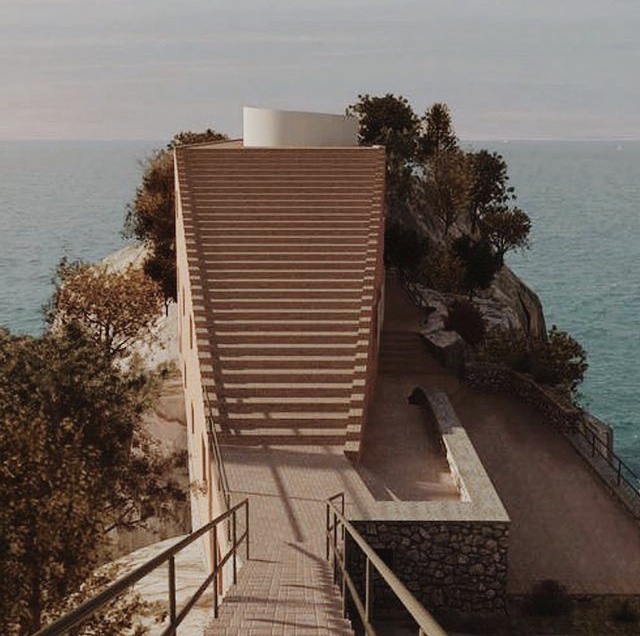
Casa Malaparte, Adalberto Libera, Curzio Malaparte 1938-43
Villa Malaparte, built in 1938 by architect Adalberto Libera in Punta Massullo on the Isle of Capri, is considered to be one of the best examples of Modern Italian architecture. The house, a red structure with inverted pyramid stairs, sits 32 meters over a cliff on the Gulf of Salerno.
After the death of Curzio Malaparte in 1957 the house was completely abandoned, spending much of the twentieth century in a state of total disrepair.
In 1961, Jean-Luc Godard shot his acclaimed film Le Mépris in Villa Malaparte. In this film, the architecture takes on a leading role and becomes closely linked to the script of the film.
It was not until the late 1980s and early '90s that serious reconstruction and restoration of Villa Malaparte began. These were led by Niccolò Rositani (the great-nephew of Curzio), thereby repositioning the house into the public eye once more.
LIBRARY of curated by ATELIER

Kissing in the 1970’s, photo by Joseph Szabo
.Contact.
For inquiries please contact
angiepalmai@me.com
︎︎︎curated by ATELIER
︎︎︎The Journey Matters
︎︎︎Linkedin Angie Palmai
For inquiries please contact
angiepalmai@me.com
︎︎︎curated by ATELIER
︎︎︎The Journey Matters
︎︎︎Linkedin Angie Palmai
curated by ATELIER, 2026